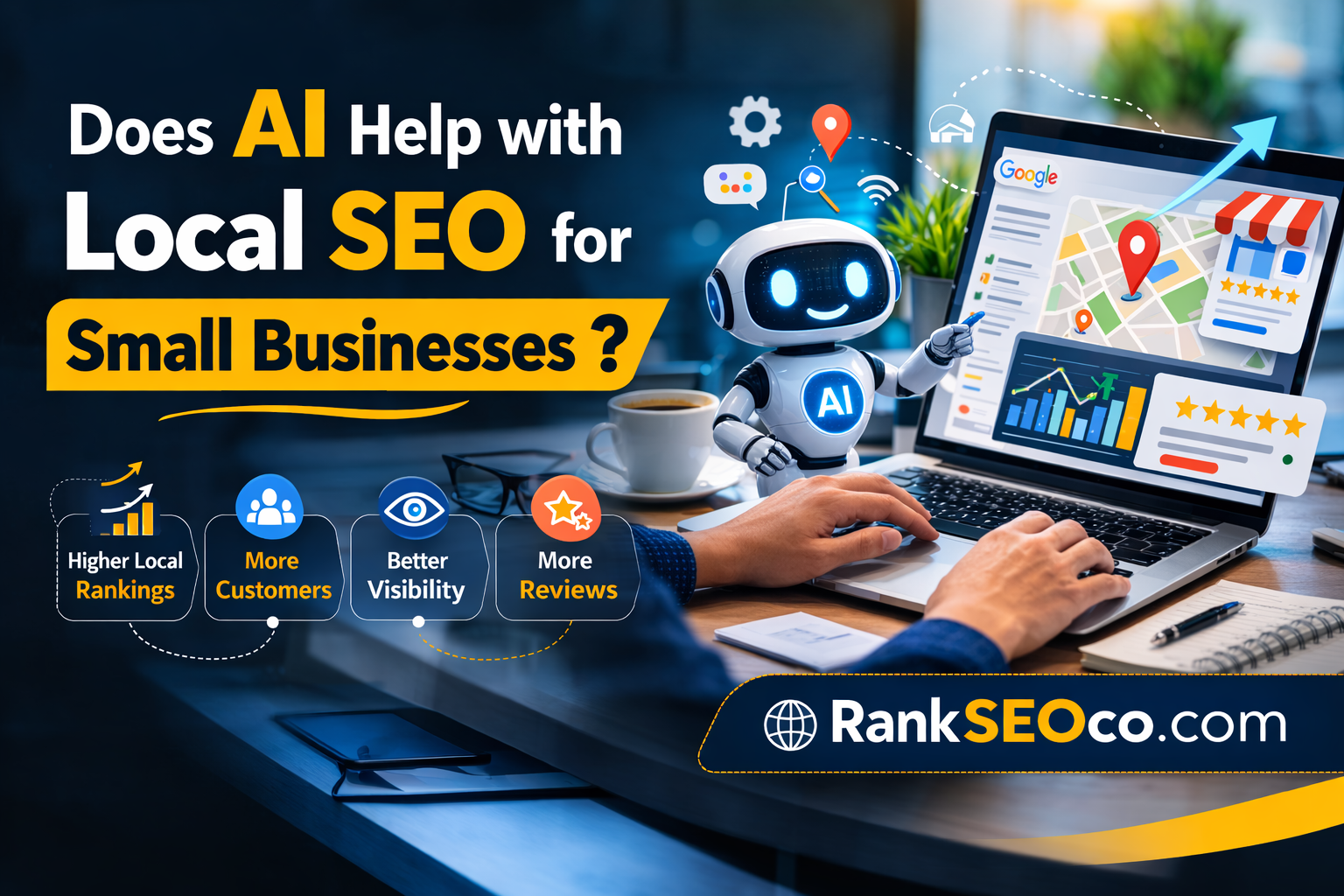
AI Help with Local SEO for Small Businesses
AI helps small businesses improve local SEO by analyzing search behavior, optimizing Google Business Profile listings, discovering local keywords, and automating content and review management. With AI tools, businesses can increase local search visibility, attract nearby customers, and compete more effectively in their local market.
Book A
Free
Consultation For Affordable Local SEO Services
How Is AI Transforming Local SEO?
Comments
No Comments
Author
RankSEOco
Post Date
March 8, 2026


"AI does not replace local SEO effort. It makes your strategy smarter, faster, and more focused on what local customers are actually searching for. 🚀
- Yousaf CEO of RankSEOco
AI and Local SEO: What’s Changing and Why It Matters
From my experience working on campaigns for small regional brands, the biggest shift in local SEO comes from how artificial intelligence is shaping a new smart search landscape where industry experts now rethink strategy inside a constantly evolving search landscape built around personalized search and competitive search.
These local search changes redefine how local search works, actively reshaping local search and pushing businesses toward staying competitive by understanding changes and the critical ways AI is changing local SEO through artificial intelligence-embedded local search strategies that help small businesses adapt their local search strategies and broader digital strategies.
The AI local SEO movement reflects the rise of AI local SEO practices that influence visibility search through smarter tools designed to interpret user intent and deliver accurate local search results that improve search engine optimization beyond old manual updates and trial-and-error SEO methods, using smarter search tools to expand local search visibility while transforming visibility search through AI-driven local SEO and ongoing search transformation.
Businesses now focus on adapting local search strategies within an evolving search landscape where local search competition is growing and AI adoption in small businesses is increasing as the AI role in local visibility strengthens presence in a competitive local market.
This ongoing search strategy transformation fuels personalized search results powered by embedded artificial intelligence strategies, accelerating local SEO transformation and expanding AI search visibility that gives companies a local SEO competitive edge while responding to new expectations in search.
To remain visible in local search and relevant in relevant local search environments, brands must explore AI local SEO while supporting digital strategy reshaping during the ongoing local search evolution where adapting small businesses’ AI becomes necessary as embedded AI strategies for local search continue transforming local visibility search through intelligent local search optimization, AI local ranking strategies, smarter SEO strategies, and scalable AI search transformation strategies.
AI Help with Local SEO for Small Businesses
AI’s Expanding Role in Search Engine Algorithms
Modern search engines rely heavily on machine learning and adaptive algorithms that interpret query words within a deeper search context, helping decode user intent through behavioral signals that generate more precise hyperlocal results.
I often reference insights from Ronnel Viloria, Lead SEO Strategist at RankSEOco Marketing Agency, who explains how searches like “best marketing agency near me” during a Friday night search combine past choices, current location, and store hours to fine-tune results, creating highly accurate precision search results that highlight the growing AI local SEO role powered by real-time data shaping search outcomes.
These systems reward algorithm relevance and measurable engagement signals, which means AI SEO small businesses must monitor online cues like review responses, content accuracy, and listing updates while maintaining accurate listings, publishing high-quality content, and building strong review signals to stay competitive in competitive local SEO.
Maintaining online details consistency, producing helpful community content, and actively engaging reviews now sit at the center of an effective SEO strategy driven by AI-driven local SEO strategies and constantly evolving algorithms that prioritize localized signals.
Businesses that ignore these signals risk fading into invisible search results because modern systems interpret meaning search, analyze query words, and perform search algorithm analysis through advanced context interpretation search that evaluates location-based signals, behavioral search data, and other signals behind relevant search results and hyper-local search results.
These improvements enable predictive search behavior, deeper personalized search precision, and constant evaluation of real-time search signals, local ranking signals, and broader algorithm ranking factors tied to engagement metrics, SEO, and search data analysis.
When studying user search behavior, it becomes clear that algorithm learning systems depend on local relevance signals, online reputation signals, and content relevance signals to increase AI search precision, strengthen local business visibility signals, and ultimately deliver results shaped by AI-powered search algorithms.
Using AI to Discover Long Tail and Conversational Keywords
Traditional SEO once relied on static keyword tools focused on broad terms and high-volume keywords such as the “plumber” keyword, “best pizza” keyword, or “tax help” keyword, which produced traffic generation keywords but often ignored keyword specificity found in descriptive searches and conversational searches typed into a mobile search bar or spoken through device voice search.
In simple terms, people now submit queries like a dentist search query asking for the best dentist near me that takes walk-ins, yet traditional keyword platforms struggle to capture detail or interpret search nuance, leaving behind simplified intent terms that create search gaps between real queries and business-published content.
This is where AI keyword discovery and AI keyword analysis transform research by studying real-time search behavior, natural language patterns, and deeper user intent analysis that reveals long-tail queries and conversational queries overlooked due to traditional tools’ limitations.
AI systems detect emerging topics, analyze semantic variations, and identify question-based searches that allow businesses to produce aligned search content reflecting how users speak and search behavior in real situations.
Modern AI local SEO tools perform continuous language usage analysis using real-time search queries, voice inputs, and various question formats along with location-specific patterns to uncover intent-driven queries that generate higher engagement queries and faster conversion searches.
In practice, these insights mirror real-world search behavior, unlocking new ranking opportunities that older methods miss due to static keyword research limits, while enabling smarter conversational keyword research built on semantic search queries, AI search trend discovery, and deeper keyword behavior analysis.
The result is stronger optimization for voice search queries and local SEO, better targeting through natural language SEO keywords, understanding user search language patterns, implementing conversational SEO optimization, improving search intent keyword discovery, uncovering local keyword variations, refining long-tail keyword targeting, and supporting better planning through AI keyword research insights.
Streamlining GBP Management With AI Tools
For many local businesses, the most important asset in local visibility today is Google Business Profiles, since well-optimized GBP listings dominate business listing searches, influence search result visibility, and appear across map results and voice search results, where customer decisions often depend on the relevance and completeness of a listing’s profile.
Effective AI local search optimization requires actively managing GBP listing tasks like responding to reviews, maintaining hours, confirming up-to-date hours, and writing business descriptions that clearly communicate value during constant, time-sensitive updates that normally require intensive manual profile management beyond the capacity of most small teams’ workloads.
This is where AI-enhanced local SEO provides increased visibility and automation, helping brands AI-write review responses and craft company descriptions, a practice also noted by Tim Clarke, senior reputation manager at Thrive Local. Automation keeps automation profiles active, maintains optimized profiles, enables faster responses for businesses, and supports consistent responses aligned with AI-driven local SEO strategies that improve responsive profile engagement.
Advanced systems now support Google Business Profile optimization, GBP management automation, and scalable local search listing management that strengthens business profile optimization through continuous AI automation profile updates, ensuring business listing accuracy and stronger profile relevance signals that impact local map ranking signals.
With features like review response automation, automated profile management, and AI business description generation, companies improve listing engagement signals, increase local business visibility maps, deploy smarter profile optimization systems, and enhance customer engagement listings through modern GBP SEO optimization tools built for efficient AI local business management.

Creating Hyperlocal Content With AI But Keeping It Human
In markets shaped by intense local content marketing competition and saturated markets, strong rankings depend on sending clear relevance signals to search engines that connect brands with nearby customers while maintaining scalable content scale production without losing an authentic content voice. Achieving this requires a careful AI local search optimization balance because although AI improves AI speed content, it must complement human creative content rather than replace it.
I often treat AI as an AI assistant content system inside broader AI content workflows used to generate outlines, support planning topics, and accelerate keyword research automation while still protecting brand-nuanced content during repetitive automation tasks in SEO.
Insights from Ron Evan Del Rosario, Senior Link Building Manager at RankSEOco, illustrate this perfectly with examples like a coffee shop Austin brand using AI to generate blog topics and guide social post planning while preserving the laid-back, locals-first Texan vibe expressed through humorous content, local slang content, and authentic regional stories created through human insight and storytelling.
Maintaining quality often requires a content review matrix that ensures brand tone consistency, validates community relevance signals, and confirms customer resonance signals during every AI-generated content review so the business identity voice and community connection messaging remain authentic.
Without oversight, businesses face duplicate AI content risk, low-quality AI content, and broader AI-powered local SEO risk that may disconnect the local audience and weaken community belonging SEO. Even when AI produces grammatically correct, keyword-rich sentences, it may miss regional slang nuance, local culture through local happenings context, and deeper customer pain points content that shapes real cultural context signals.
These factors influence engagement signals SEO, trust signals, SEO, and overall ranking signals for search engines, which is why human oversight SEO protects authenticity signals. SEO is rooted in real-voice content, lived-experience content, and meaningful local context that sustain long-term visibility and build sustained trust signals.
Platforms like the Google Helpful Content System now prioritize firsthand experience content and local expertise signals, encouraging smarter AI content structure ideation grounded in local insight grounding through methods like employee interviews, collecting customer stories, and highlighting organic community moments that strengthen optimized content signals, produce a real-sounding brand voice, support a credible local content strategy, and reinforce authentic engagement signals.
AI Help with Local SEO for Small Businesses Guide
AI is changing how small businesses approach local SEO. Modern tools powered by artificial intelligence help businesses understand user intent, analyze local search behavior, and optimize content for better visibility in search results.
Instead of relying on manual SEO tasks, AI tools can assist with keyword research, competitor analysis, content optimization, and Google Business Profile management. This allows small businesses to identify long-tail keywords, improve local rankings, and target nearby customers more effectively.
AI-driven local SEO strategies also help analyze search patterns, customer reviews, and engagement signals to improve search performance. Businesses can use AI to discover conversational search queries, optimize location-based content, and monitor online reputation across platforms. These insights help create more relevant content that aligns with how users search locally.
For small businesses, AI also simplifies many time-consuming SEO tasks. AI tools can track ranking signals, detect SEO opportunities, suggest content improvements, and automate review responses. When used correctly, AI helps improve local search visibility, attract more local traffic, and increase customer engagement.
Using AI in local SEO does not replace human expertise. Instead, it supports smarter decision-making by providing data-driven insights and automation. Small businesses that combine AI tools with authentic local content and strong customer interaction can build a stronger online presence, improve local search rankings, and compete more effectively in their local market.
Sentiment Analysis Through AI Powered Review Monitoring
The influence of customer reviews on SEO continues to grow because they directly affect search visibility signals and brand trust signals, while a steady positive feedback flow can drive local ranking increases, and unresolved issues like negative reviews’ impact or unanswered reviews’ credibility loss can cause measurable conversion rate impact.
Managing this environment requires monitoring reviews at scale across multiplatform reviews and multi-location reviews, a process that once involved time-consuming monitoring but now benefits from AI-effective monitoring through advanced sentiment analysis tools built on machine learning analysis.
These systems process large volumes of feedback, detect tone feedback, perform urgency detection, and highlight patterns such as recurring issue detection, allowing smarter business owners to review monitoring through automated AI review scanning that quickly surfaces flagged reviews’ attention. Early signals often reveal operational issue signals, deeper service trend insights, and even product gap insights, enabling early issue detection before problems escalate.
AI can also generate review response drafts, which still benefit from human review and editing, a principle often reflected in the Tim Clarke statement emphasizing balance between AI background systems and human-tone context accountability. In practice, AI provides AI analysis suggestions and response language suggestions while humans finalize personal review responses that deliver quick replies to customers and maintain clear communication with customers.
Together these workflows power AI-powered local SEO systems capable of handling review volume management while preserving human oversight, responses, and ensuring authentic customer communication through scalable review management.
This system strengthens trust-building responses, supports reputation monitoring systems, reveals patterns through feedback pattern analysis, generates customer sentiment insights, and reinforces important online reputation signals and review engagement signals.
Businesses that adopt AI review response automation alongside structured reputation management monitoring gain access to actionable review feedback intelligence that ultimately drives measurable service improvement insights.
Put AI SEO for Small Businesses to Work in Your Local Market
After working with several regional brands, I have seen how AI SEO small business strategies become practical only when businesses actively apply AI local SEO insights in real local markets.
The shift starts when companies treat AI-driven local SEO strategies as part of everyday SEO strategy, using AI local ranking strategies, AI-powered search algorithms, and AI keyword research insights to strengthen local business visibility signals and capture ranking opportunities that many competitors miss.
In practice, businesses combine AI local search optimization, consistent Google Business listing optimization, and stronger local keyword variations discovered through AI keyword discovery and AI search trend discovery.
When brands support these tactics with high-quality content, maintain accurate listings, and respond to customer reviews SEO through structured reputation monitoring systems, they strengthen both online reputation signals and review engagement signals that influence search visibility signals across map results, voice search results, and traditional search results visibility.
The strongest growth often appears when AI supports real community signals through community content, authentic customer story content, and active customer engagement listings that reinforce relevant search results and stronger personalized search results.
Over time this approach improves local ranking signals, drives measurable search outcomes, and builds long-term local search visibility that keeps businesses competitive in an increasingly competitive local market shaped by AI search transformation strategies.
Related Blogs

Why Proxy-Checker Is the Go-To Tool for Proxy Verification