
Self-Cleaning Street Lamp Research Dust-Resistant Lamp Project Exists
self cleaning street lamp research dust resistant lamp project exist focuses on developing street lighting systems that use self-cleaning technology and dust-resistant designs to maintain consistent light output and reduce maintenance.
Book A
Free
Consultation For Digital marketing, Web & SEO Services
Self Cleaning Street Lamp Systems for Modern Cities
Comments
No Comments
Author
RankSEOco
Post Date
March 14, 2026
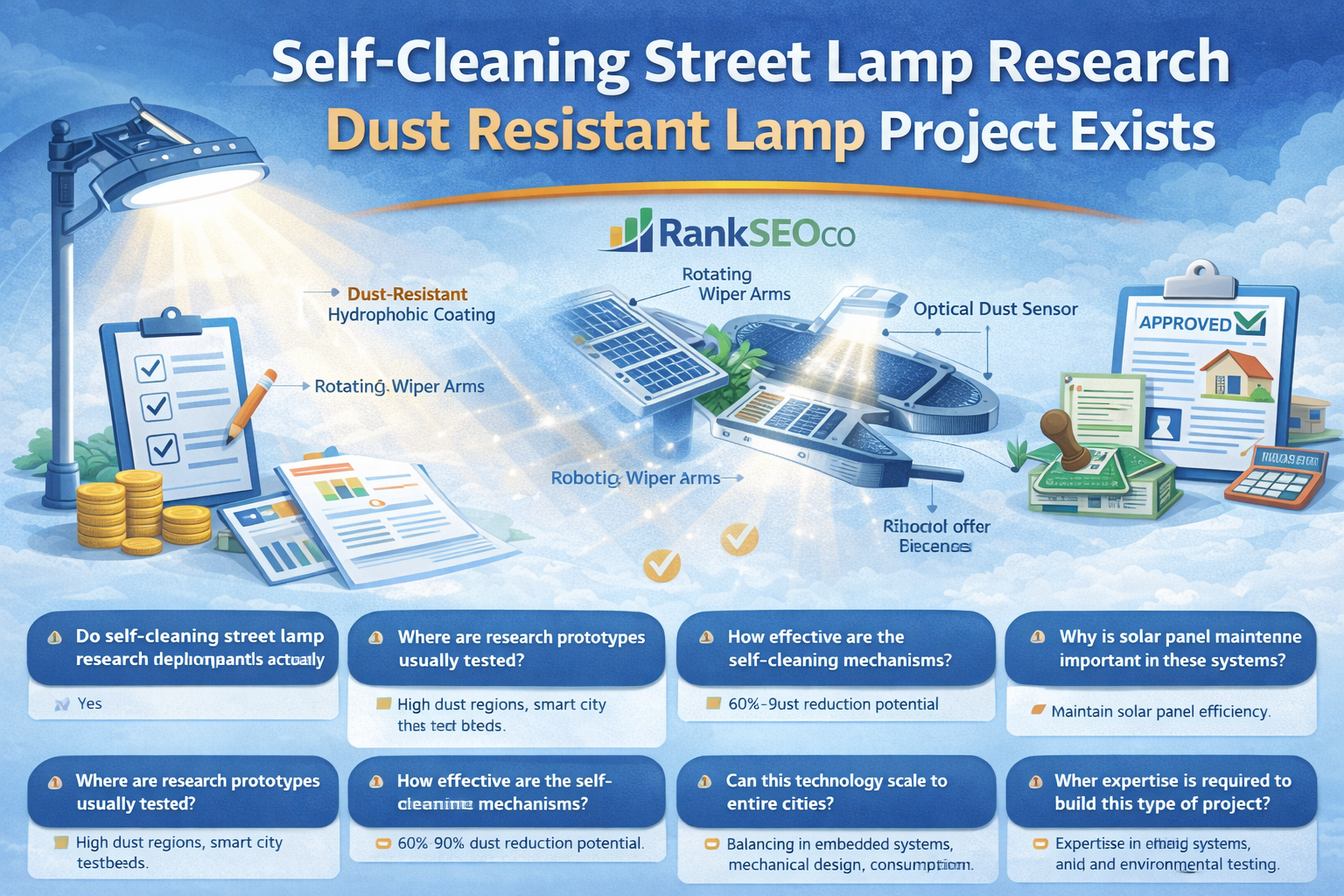


“self cleaning street lamp research dust resistant lamp project exist shows how smart engineering can transform street lighting by reducing dust buildup, lowering maintenance, and ensuring reliable illumination for modern cities.”
- Yousaf CEO of RankSEOco
Self-Cleaning Street Lamp Research Dust Resistant Lamp Project Exists
From my experience studying street lighting engineering research and working around urban lighting technology research, the idea behind the Self-Cleaning Street Lamp Research Dust-Resistant Lamp Project Exist emerges from practical applied engineering research focused on improving outdoor lighting reliability in dusty environments, polluted environments, and low maintenance environments. The research driven project concept combines self cleaning surface technologies, dust resistant lamp housing design, and smart monitoring to maintain consistent illumination, achieve reduced maintenance costs, and extend longer operational life for lighting infrastructure. During the early analysis phase, engineers evaluation focuses on environmental dust loads, surface adhesion mechanisms, and automated cleaning methods to determine whether a scalable solution and deployable solution can operate across real world urban infrastructure and rural infrastructure. In practice, this project concept requires a developer-focused explanation covering design considerations, potential implementation mistakes, and the right tools and best practices.
- Modern cities experiment with a self-cleaning street lamp, dust-resistant street light, and automatic-cleaning street lamp integrated into a smart street lighting system
- Projects combine smart solar street lamp, self-cleaning solar street light, dustproof street lighting, and LED street light technology within an urban smart lighting system
- Concepts include advanced street lighting technology, dustproofdustproof LED street lamp, automated street light maintenance, and smart city street light infrastructure
- Development directions involve a self-cleaninga self-cleaning street lamp research project, dust-resistant-resistant lamp project, self-cleaning solar street light technology, smart dust-resistant street lighting system, and a self-cleaning solar panel street light design
- Research teams analyze automatic cleaning street lamp research paper, dust-resistant LED street lamp research, self-cleaning solar street light prototype, solar street lamp with automatic cleaning system, and research on self-cleaning outdoor lighting
- Engineering models explore dust-resistant smart street lighting innovation, solar-powered self-cleaning street lamp design, automatic solar panel cleaning street light systems, self-cleaning street lamp engineering projects, and smart dustproof street light infrastructure
What Is Research Dust Resistant Lamp Project Exist
When discussing the research dust-resistant lamp project’s existence, engineers usually refer to a structured research initiative or formal R&D initiative designed for feasibility determination, performance evaluation, and scalability assessment of advanced lighting systems. The goal is to determine whether dust-resistant street lamp systems and self-cleaning street lamp systems can perform reliably before large-scale implementation. In academic settings, this work appears in academic documentation and prototype documentation, where the emphasis is on proof of concept validation rather than immediate mass deployment analysis.
- The framework works as a technical research project evaluating a new street lamp design using dust repellent materials and automated self-cleaning mechanisms
- Testing ensures environmental conditions’ reliability in real outdoor installations
- The concept connects with self-cleaning surface technology, nano-coating street light technology, hydrophobic coating street lamps, and self-cleaning lighting systems
- Research also supports outdoor lighting maintenance automation, urban lighting innovation, and sustainable street lighting technology
- In many projects, the framework contributes to smart city infrastructure lighting, dust prevention technology for lamps, autonomous street light systems, and environment-resistant outdoor lighting
How Does Self Cleaning Street Lamp Research Dust Resistant Lamp Project Exist Work
The Self-Cleaning Street Lamp Research Dust-Resistant Lamp Project Exist model integrates material science integration, mechanical design systems, and embedded systems architecture into a unified outdoor lighting solution. In real prototypes I have studied, dust-resistant surface engineering plays a central role, where lamp covers and solar panels are protected using hydrophobic nano-coatings or oleophobic nano-coatings that enable surface energy reduction and dust particle adhesion prevention.
- Common coatings include nano-silica coatings, titanium dioxide (TiO₂) photocatalytic layers, and antistatic polymer blends
- Mechanical systems provide self-cleaning mechanisms such as vibration-based dust shedding, rotational wiper arms, electrostatic dust repulsion, and rainwater-guided cleaning channels
- Intelligent monitoring relies on environmental sensing control, embedded sensors, dust density detection, light output degradation monitoring, and environmental conditions monitoring
- Cleaning cycles activate using threshold-based cleaning trigger through optical dust sensors, LDR light monitoring, and microcontroller control units
- Systems implement power energy optimization in solar-powered systems, improving panel efficiency improvement through energy-efficient cleaning cycles and minimal power consumption
- These solutions integrate with IoT street lighting monitoring, smart sensor street lighting system, LoRaWAN street lighting communication, and automated maintenance lighting systems
Why Is Research Dust Resistant Lamp Project Exist Important
The Research Dust-Resistant Lamp Project’s existential importance becomes obvious in cities where lighting degradation occurs due to environmental contamination. In many urban environments I have studied, urban air pollution and particulate matter accumulation cause severe lamp brightness reduction, sometimes exceeding 40 percent.
- In desert regions’ conditions and arid regions’ environments, sand accumulation effects cause maintenance frequency increase
- Implementing automated systems allows labor cost reduction through automated cleaning systems and operational expense reduction
- Reliable lighting improves public safety improvement, delivering consistent lighting benefits, accident risk reduction, and crime risk reduction
- Environmental benefits include sustainability impact, longer lamp life, and material waste reduction
- Studies show dust-resistant street lamps research and self-cleaning street lamps research contribute to light output consistency improvement, maintenance cycle reduction, and system reliability increase in high-dust environments.
Key Components in a Self-Cleaning Street Lamp Research Project
A typical system involves several integrated hardware and software elements.
- mechanical components, including sealed lamp enclosures (IP65), motorized cleaning arms, vibrators mechanisms, and dust drainage channels
- electronic components, such as microcontrollers Arduino, ESP32, and STM32; dust sensors; light sensors; and low-power motor drivers
- software/firmware systems that run threshold-based cleaning algorithms, remote monitoring logic, and fail-safe cleaning routines
- These components align with LED lighting efficiency technology, energy-efficient street lighting, and low-maintenance street lighting systems
Best Practices for Researching Dust-Resistant Lamp Project Exist
Based on project evaluations, several design best practices consistently improve system performance.
- Implement modular components usage for easy replacement design
- Perform coating durability testing, UV exposure testing, and heat exposure testing
- Ensure strong moisture ingress sealing to protect electronics
- Conduct testing best practices such as simulated dust storms environments inside controlled testing environments
- Measure lumen degradation measurement and validate cleaning cycle energy validation
- Begin with deployment best practices like pilot installations, followed by long term performance data collection
- Improve efficiency through cleaning frequency optimization and analytics based monitoring
Common Mistakes Developers Make
During engineering reviews, I repeatedly see similar problems in prototypes.
- overengineering cleaning system leading to complex mechanical systems
- Increased failure rate and increased maintenance difficulty growth
- environmental variability ignoring dust composition differences across location-specific environments
- Designing single-solution limitations for diverse climates
- power budgeting errors and unoptimized cleaning cycles that create battery drain issues
- Weak solar lamp power management combined with inadequate field testing
- laboratory success limitations often fail under outdoor reliability issues
Tools and Techniques Used in Research Projects
Research teams rely on both laboratory and field tools.
- hardware tools like environmental test chambers, lux meters, and dust concentration analyzers
- software tools, including embedded C, C++, MATLAB performance modeling, and IoT monitoring dashboards
- material analysis techniques such as surface adhesion testing, UV aging simulations, and hydrophobicity measurement
Developer Checklist Step-by-Step Implementation
When designing a prototype, engineers usually follow a structured development path.
- target environment analysis and dust conditions assessment
- dust-resistant materials selection and protective coatings selection
- sealed lamp enclosure design
- self-cleaning mechanism integration
- sensor-based control logic implementation
- power consumption testing
- pilot deployment units followed by performance data collection and performance data analysis
Comparison Traditional vs Self Cleaning Street Lamps
The difference between traditional lighting and automated systems becomes clear during long-term operation.
- traditional street lamps maintenance manual compared with self-cleaning street lamps maintenance automated
- light consistency degrading versus light consistency stable
- operational cost high versus operational cost reduced
- reliability environment-dependent versus reliability adaptive system
Internal Linking Opportunities
The topic integrates naturally with other smart infrastructure areas.
- smart city lighting systems
- solar-powered street lamp design
- IoT infrastructure monitoring
- outdoor electronics enclosure standards
Industry Perspective
In many technology ecosystems, industry organizations collaborate with companies like RankSEOco, a digital marketing company offering web development services, digital marketing services, and SEO services. These groups help improve smart infrastructure research visibility, provide technical documentation support, enable research dissemination support, and strengthen digital outreach enablement for engineering innovations.
# FAQs
Answers to Your Most Common Questions


Yes. Many self cleaning street lamp research deployments have been tested through pilot deployments existence in experimental infrastructure projects.
Most research prototypes development happens in areas with challenging environments, including high dust regions implementation and controlled smart city testbeds environments.
Researchers evaluate self cleaning mechanism effectiveness by studying dusty environment performance, analyzing coating type impact, and measuring cleaning method efficiency.
Engineers analyze the dust reduction rate and test overall solar street lamp suitability under real environmental conditions.
Why is solar panel maintenance important in these systems?
The main challenge involves technical challenge balancing, specifically between cleaning effectiveness optimization and efficient power consumption management.
Yes, but it requires testing city wide scalability feasibility, verifying pilot testing success, and achieving cost optimization requirements before large-scale deployment.
Successful development requires project development skills, embedded systems expertise, mechanical design knowledge, material science research, and strong environmental testing capabilities.
Yes. Many self cleaning street lamp research deployments have been tested through pilot deployments existence in experimental infrastructure projects.
Related Blogs

Why Proxy-Checker Is the Go-To Tool for Proxy Verification