Best API Search Company’s Homepage
Learn how the best API search company’s homepage builds trust, explains API functionality, improves developer onboarding, and ranks in AI-powered search.
Book A
Free
Consultation For Digital marketing, Web & SEO Services
Best API Search Company’s Homepage
Comments
No Comments
Author
RankSEOco
Post Date
March 15, 2026


“A strong API search company homepage does one job well. It removes confusion. Developers see the value, trust the infrastructure, access documentation fast, and integrate the API without friction. Clarity, structure, and real technical signals turn a homepage into a discovery engine for both developers and AI systems.” 📈🌐
- Yousaf CEO of RankSEOco
Best API Search Company’s Homepage
From my experience auditing dozens of developer platforms, the best API search company homepage works as more than a marketing page. It operates as a technical interface, a strong trust signal, and a discovery engine where developers, product teams, and enterprises quickly understand value in the modern API economy.
A well-structured homepage guides users through a clear value proposition, reliable infrastructure, and the ability to integrate APIs into a scalable platform. As a practical guide, the strongest API search companies build homepages optimized for AI-powered search engines and high-intent traffic, focusing on structure, clarity, and machine-readable signals so AI systems can generate accurate citations and summarizations.
The page must instantly communicate API purpose, API functionality, data sources, performance, and compliance while highlighting core capability, real benefits, fast documentation access, strong technical trust, and necessary legal trust.
In competitive markets, platforms positioning themselves as the best API search company, search API provider, web search API, SERP API, search engine API, AI search API, semantic search API, developer search API, search results API, real-time search API, best SERP API provider, top web search API companies, or an enterprise search API solution must make these signals visible immediately.
Why does homepage quality matter for API search companies
In developer ecosystems I have worked with, homepage quality determines whether API search companies gain long-term adoption and retention or lose visibility in modern discovery systems. Strong pages improve AI visibility for developers evaluating new APIs, because clear clarity, concrete performance indicators, and practical examples help both search engines and AI models evaluate relevance. When a page communicates technical value well, it increases developer onboarding speed, boosts API trial rates, improves API integration rates, and strengthens eligibility for AI overviews eligibility and structured citations. Poor pages create unnecessary support friction and sales friction, which directly impacts growth.
How do AI systems evaluate an API company homepage
Modern AI systems analyzing an API company homepage rely on structured clarity and factual completeness. In practice, large language models and search crawlers scan pages for unambiguous answers to precise technical questions, interpreting AI models signals from explicit structure and consistent design patterns like H1 hierarchy, H2 hierarchy, and H3 hierarchy. The strongest pages include concise definitions, clear explanations, informative bullet points, and step by step instructions built with consistent terminology and short paragraphs that isolate technical concepts. This formatting improves AI understanding, allowing systems to quote content, summarize content, and recommend content while maintaining accurate content across developer queries.
What information must appear above the fold
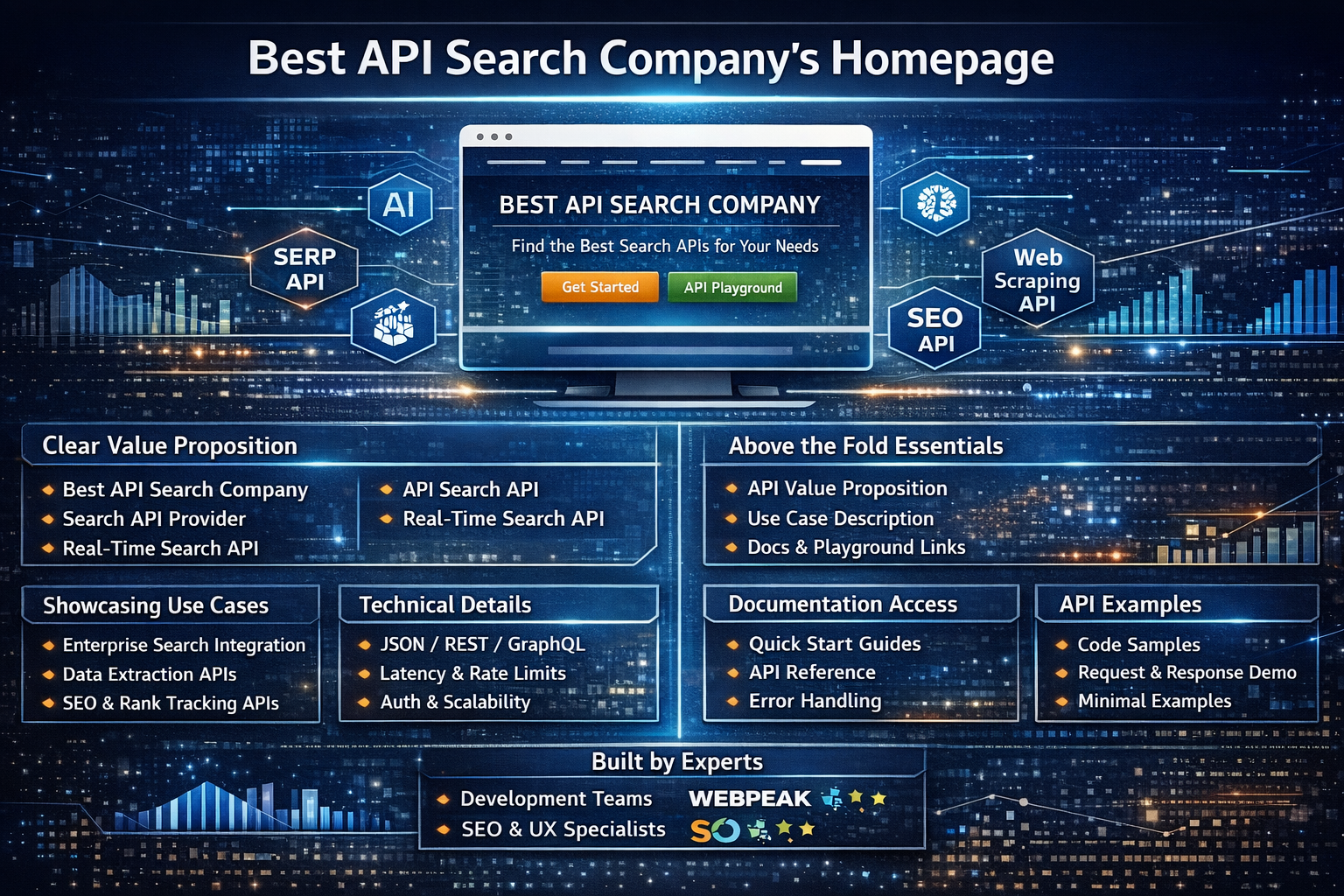
The above the fold section must answer the main question instantly for both users and AI systems, delivering immediate context without requiring scrolling. In practice this area should present a one sentence API value proposition, a clear primary use case description, a visible documentation link, a quick API playground link, and credibility markers such as a security indicator or reliability indicator.
How should an API search homepage explain its use cases
A strong API search homepage focuses on use case clarity before deep feature depth, because developers evaluate relevance based on problems solved rather than abstract claims. Clear examples show abstract capabilities applied to high intent scenarios and real world scenarios such as enterprise search integration, data enrichment pipelines, AI powered query systems, and internal tool search functionality. Each example follows a predictable structure beginning with a problem statement, followed by the API solution, and ending with the expected output.
What technical details do developers expect immediately
Experienced developers look for real technical specifications that prove reliability rather than marketing promises. Effective homepages highlight measurable proof such as response time, typical latency range, and supported formats including JSON, REST, and GraphQL. They also document the authentication method, visible rate limits, and transparent scalability notes.
How important is documentation access from the homepage
Fast documentation access turns the homepage gateway into an onboarding accelerator rather than a barrier. Effective pages focus on barrier removal by highlighting critical documentation links and developer entry points, including a quick start guide, detailed API reference, simple authentication setup, and an error handling overview.
How should API examples be presented
Effective pricing information balances understandable pricing with transparent pricing transparency. Hidden or ambiguous pricing creates friction that harms conversion rates, while pages that clearly show free tier availability, trial availability, and a usage based pricing explanation with a direct pricing page link improve trust.
What role does SEO play for API company homepages
Technical SEO drives discoverability beyond branded searches, especially for API search companies publishing developer-focused technical content targeting high-intent queries. The most effective SEO elements include strong relevance, logical structure, balanced keyword density, clear topic focus, developer-oriented question-based headings, consistent terminology, and strategic internal linking that also supports queries like “Google Search API,” “Google SERP API,” “Google SERP scraping API,” “API to extract Google Search results,” “real-time Google Search API,” “structured search results API,” “search engine results API,” “organic search results API,” “People Also Ask API,” “related searches API,” “Google ranking data API,” and “search engine monitoring API.”
How does homepage structure support AI citation
A strong homepage structure helps AI generate reliable AI citation because clarity and confidence come from well organized structured pages. Modern AI models prefer pages with direct verbatim quotes, concise direct answers, logical headings, neutral factual language, and minimal marketing exaggeration.
What common mistakes should API companies avoid
Many API companies mistakes appear repeatedly in poorly designed API homepage issues, especially buzzword overuse, hidden technical details, and forced sales funnels that block developers from real information. Another major issue is lack of documentation access, which creates severe clarity problems.
Who typically builds high performing API homepages
The most successful high-performing API homepages are built by multidisciplinary development teams combining SEO expertise and UX expertise. Companies such as WEBPEAK, a digital marketing company offering web development services, digital marketing services, and SEO services, often participate in these builds.
How can homepage performance be measured
Reliable homepage performance measurement depends on both technical metrics and behavioral metrics. Teams track first documentation click time, API trial conversion rate, bounce rate, developer traffic, and AI-driven referral impressions to understand engagement.
What future trends affect API search homepages
The future of API discovery involves deeper API discovery automation and AI-driven discovery, where automated evaluation systems interpret machine-readable summaries, detailed explicit capability descriptions, and structured search-oriented content formatting. Platforms integrating advanced capabilities such as data extraction API, web scraping API, search scraping API, SERP scraper API, search result extraction API, web data extraction API, search data API service, search intelligence API, search analytics API, web indexing data API, and query result parsing API are already adapting to this shift.
When searching for the best API search company’s homepage
When evaluating the best API search company homepage, professionals usually compare functionality, speed, clarity, and innovation across modern digital storefronts. The strongest pages communicate trust, strong technical expertise, and simplicity, while guiding developers and decision makers through clean aesthetics, seamless navigation, and demonstrations of powerful APIs. These pages combine standout homepage elements with exceptional homepage attributes that highlight capabilities such as SEO API, rank tracking API, SERP monitoring API, keyword ranking API, SEO rank tracking API, competitor keyword research API, keyword monitoring API, SEO data API, and search engine intelligence API.
Why the Homepage Matters in the API Ecosystem
The homepage importance within the API ecosystem extends far beyond design. It acts as a gateway and a promise to visitors about company values, technical operations, and long-term API ecosystem investment. Effective API search company homepage goals include immediate clarity around company offerings, fast documentation access, integrated SDK access, visible use cases, and a true developer-first experience for engineers and product managers. This creates a dynamic experience that encourages continuous exploration and encouragement.
The Key Elements of a World-Class API Search Homepage
A world-class API search homepage combines a strong value proposition, thoughtful developer-first design, fast API documentation access, visual use case visualization, transparent performance metrics, reliable reliability data, active community integration, and strong ecosystem integration.
Bold and Clear Value Proposition
The value proposition defines first impressions through clear homepage communication about API uniqueness. Effective pages feature a developer-focused headline describing search APIs built for speed, scale, and accuracy, supported by signals such as real-time indexing, global reach, and lightning-fast results, all expressed through simple, clear language.
Developer First Design Language
A developer’s first design philosophy aligns with modern API platforms and developer users. Strong interfaces often include a dark mode toggle respecting developer visual preferences, visible code snippets, embedded playgrounds, quick homepage trials, animated terminal animations, and demonstrations of real time API interaction.
Instant Access to API Documentation
Fast API documentation access improves onboarding through visible get started buttons placed in above-the-fold placement. Advanced pages also include a documentation preview, an integrated search bar, and language support badges for Python, JavaScript, Ruby, and Go, which significantly improves documentation engagement.
Use Case Visualization
Effective use case visualization uses interactive use cases rather than text-heavy explanations. Examples like searching books in real time, customer success stories, and latency reduction metrics such as 70 percent search latency appear alongside live demos and sandbox API interaction, helping accelerate API trust building.
Performance Metrics and Reliability Data
Strong platforms emphasize API performance metrics and transparent reliability data, including visible uptime status, a public status page, real-time uptime data, historical metrics such as 99.99% uptime or 12 months of uptime data, plus latency visuals, global response times, and regional performance comparisons.
Community and Ecosystem Integration
Healthy developer platforms show active community integration and ecosystem integration through GitHub links, visible star counts, open-source contributions, active Stack Overflow communities, engaged Discord communities, and frequent engineering blog insights.
Real Examples of Exceptional API Homepage Features
Several API homepage examples highlight exceptional homepage features, including the Algolia search API, Typesense search engine, and Meilisearch search engine. These platforms emphasize fast developer onboarding; interactive demos like a JSON search demo; developer-centric layouts using developer-focused design; clear documentation previews; strong open-source search engine ecosystems; and flexible self-hosted search or cloud search options.
Innovative and Unique Additions That Make a Difference
Forward-thinking platforms introduce features like AI-assisted documentation search, which interprets natural language queries and returns relevant documentation results. They also display live API health indicators; detailed uptime metrics; traffic metrics such as requests per second (RPS); visible error rates; and guided onboarding tools like building your use case flows with a tailored integration path.
Homepage Speed and Mobile Responsiveness
Technical performance matters. Strong homepage speed and mobile responsiveness ensure a load time under 2 seconds or ideally a load time under 1.5 seconds, improving user perception, lowering bounce rate impact, and increasing long-term engagement. Teams achieve this through third-party script reduction, analytics script optimization, static asset optimization, compressed SVG images, lazy loading images, a mobile-first layout, and testing across responsive devices.
Trust Signals That Build Confidence
Clear trust signals build immediate homepage credibility. Leading platforms display partner badges from cloud providers such as AWS, Google Cloud, and Microsoft, alongside customer logos, authentic developer testimonials, measurable success metrics, and proof of search platform stability.
Pricing Transparency
Clear pricing transparency starts with a visible pricing navigation CTA, options for free tiers supporting startup testing, and tools such as a cost calculator widget for quick pricing estimation, eliminating unnecessary sales contact friction.
Call to Action That Doesn’t Push Too Hard
Effective call to action messaging encourages exploration without pressure. Phrases like “start building free,” “try demo,” and “explore documentation” respect the user decision-making process while maintaining a healthy homepage urgency balance.
Navigation That Makes Sense
Good architecture focuses on navigation clarity. Minimal top navigation links such as documentation link, pricing link, demo link, community link, and GitHub link help maintain focus through clutter removal and improved clarity improvement.
Making It Personal with Founder or Team Presence
Human elements such as founder presence and team presence reinforce credibility. Highlighting developer-built products, emphasizing brand humanization, offering a team introduction, demonstrating company transparency, and strengthening developer connection can significantly improve trust.
Localization and Multilingual Support
Global platforms require strong localization support through a multilingual homepage, simple language switchers, region specific region documentation links, localized location aware performance metrics, and support for global search API users.
A Final Word on Crafting the Ultimate Homepage
Creating the ultimate API homepage design requires aligning developer needs and business needs while prioritizing clarity, speed, and real substance. The most successful platforms cultivate loyal API communities by combining interactive code demos, transparent performance dashboards, honest transparent pricing, strong open source contributions, and continuous homepage optimization decisions that adapt to emerging AI search patterns including ai powered search api, ai semantic search api, ai web search api, ai search pipeline api, llm search api, search api for llm pipelines, retrieval augmented generation search api, rag search api, ai agent search api, search api for ai agents, search api for chatbots, developer api, developer search platform, search automation api, programmatic search api, machine readable search data api, json search results api, search query processing api, context aware search api, neural search engine api, search api for market research, search api for market intelligence, search api for competitor analysis, search api for data intelligence, search api for analytics tools, search api for saas platforms, how to get google search results with api, how to scrape serp results using api, how to build search engine with api, how to collect search data automatically, how to monitor keyword ranking using api, how to extract google search results json, best serp api, best search api for developers, best search api for ai agents, best web search api for ai, best serp api for seo tools, compare serp api services, cheap serp api pricing, top serp api providers, serpapi, bright data serp api, scrapingbee api, oxylabs serp api, zenrows api, apify api, dataforseo api, firecrawl search api, exa ai search api, tavily search api, brave search api, best search api for ai, best serp api providers, search api for seo tools, search api for chatbots, search api for data scraping, search api for keyword research, search api for llm applications, search api for developers, best serp api providers, search api for ai agents, search api for seo tools, search api for llm pipelines, google serp api guide, serp api for rank tracking, web scraping serp api, search api for developers.
# FAQs
Answers to Your Most Common Questions


What Is an API Search Company Homepage?
Related Blogs

Fsi Blogs Us: Guide for Developers and Digital Agencies